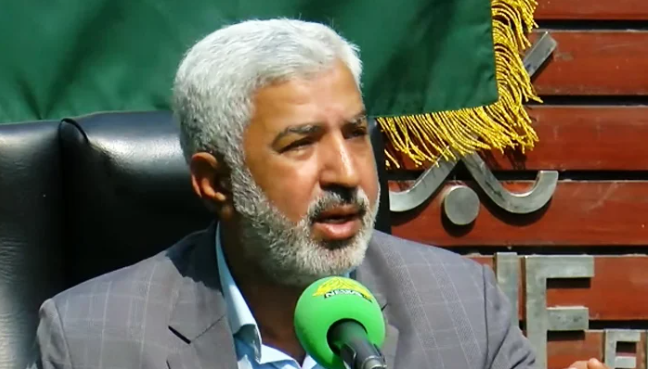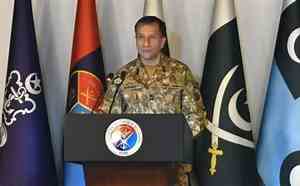
ISLAMABAD: Inter-Services Public Relations (ISPR) Director General (DG) Lieutenant General Ahmed Sharif Chaudhry said on Tuesday that Afghans were involved in major “high-impact” terror incidents in Pakistan in 2025.
At the outset of the press conference, the military’s spokesperson said that the purpose of the briefing was to give a comprehensive overview of counter-terrorism measures taken in the past year.
This “is the only purpose of this press conference, and I would request that we remain focused on counter-terrorism as terrorism is the biggest threat that is being faced by the state of Pakistan,” he added.
The DG ISPR said 2025 was a “landmark and consequential year in our fight against terrorism”, adding there were four reasons behind this conclusion.
He maintained that the fight against terrorism concerned the entire nation and had been ongoing for more than two decades. The DG ISPR further stated that the past year witnessed “unprecedented intensity in counter-terrorism efforts.”
In 2025, he continued, the state of Pakistan, as well as the people, gained “complete clarity on terrorism”.
“The state already had this clarity, which permeated slowly and gradually down[ward] that these terrorists are khawarij [and] they have no relation with Islam. They are Fitna-al-Hindustan and have no relation with Pakistan or [the people of] Balochistan,” he elaborated.
Fitna-al-Khawarij is a term that the state has designated for the banned Tehreek-i-Taliban Pakistan (TTP), and it uses Fitna-al-Hindustan for Balochistan-based terrorist groups to highlight India’s alleged role in terrorism and destabilisation across Pakistan.
Lieutenant General Chaudhry further highlighted that in 2025, the world acknowledged Pakistan’s stance and narrative regarding terrorism, particularly Afghanistan becoming a “base for terrorist operations”.
Moreover, he added that the past year also demonstrated “how the National Action Plan (NAP) was reinvigorated and how it was being implemented”.
In this connection, he also mentioned that the vision for Azm-i-Istehkam — a counter-terrorism operation launched by the military in 2024 — was drawn from the revised NAP, and that all political parties and segments of society had reached a consensus on the necessity of implementing the NAP to eliminate terrorism.
He acknowledged, however, that “there are still deficiencies, and there is a lot of room for improvement” in the implementation of the NAP.
After outlining these four factors as the reasons behind declaring 2025 a “landmark and consequential year” in counter-terrorism, the DG ISPR went on to discuss them in detail.
.A screengrab from the presentation played at the DG ISPR’s press conference on January 6.
He began by sharing data, according to which law enforcement agencies of Pakistan — including the army, police, Federal Constabulary, and intelligence agencies — conducted a total of 75,175 intelligence-based operations (IBOs) in 2025.
“Which comes down to 206 IBOs per day,” he said. Breaking it down, he noted that 14,658 operations were conducted in Khyber Pakhtunkhwa, 58,778 in Balochistan, and 1,739 in other regions of Pakistan.
He added that 5,397 terror incidents took place in Pakistan last year, of which 3,811 were reported from KP (71pc), 1,557 from Balochistan (29pc), and 29 from other areas.
Moreover, 2,597 terrorists were killed in Pakistan in 2025, the DG ISPR said. Among them, 1,800 were killed in KP, 784 in Balochistan, and 10 in other areas.
In 2025, he continued, 1,235 law enforcement personnel and civilians were martyred in the fight against terrorism.
Sharing data about suicide bombing incidents, he said a total of 27 had taken place in 2025. Of these, 16 occurred in KP, 10 in Balochistan, and one in Islamabad, at the judicial complex.
“Out of them, two [involved] female suicide bombers.”
In light of these facts and figures, he said, the question that came to mind was why the majority of terror incidents took place in KP.
“The primary reason for this is the politically conducive environment provided [to terrorists], and the political-terror nexus that is flourishing in the province,” he said.
The DG ISPR highlighted that data show terrorism began to rise in 2021. A total of 193 terrorists were killed that year compared to 592 law enforcement personnel who were martyred, a ratio of 1:3, he added.
Moving to 2025, he pointed out that 2,597 terrorists were killed last year, while 1,235 law enforcement personnel were martyred. This translated to a ratio of 2:1, he added.
“But more importantly, what happened in 2021 that caused terrorism to rise?” he questioned, and he elaborated on the reasons behind this development.
The DG ISPR explained that there was a change in Afghanistan in 2021 following the Doha Agreement.
“An armed group, the Afghan Taliban, sat down with the US and international partners and enter an agreement. Under the agreement, they made three commitments — that they will form an inclusive government in Afghanistan, use of Afghan soil for terrorism will not be allowed and women will be given rights [in Afghanistan],” the DG ISPR recalled.
But were the commitments fulfilled, the military spokesperson questioned.
“They were not. Is there a government there? There is no government there. They [just] call themselves interim Afghan government […] Is there an inclusive government there? No, there is not.”
“Has terrorism been eradicated [from Afghanistan]? Contrarily, Afghanistan has become a hub of terrorists and non-state actors. Terrorists of different creeds operate from there. So that is what started happening in 2021.”
Naming various terror outfits that he said were operating from Afghanistan, the DG ISPR said Afghanistan had become a “centre point where terrorists of all kinds are being nurtured”.
He said that around 2,500 terrorists, who were neither Afghans nor Pakistanis, had recently reached Afghanistan from Syria.
The military spokesperson also said that the Afghan Taliban, “which is now the mother organisation,” had started organising the TTP according to its organisational structure. The DG ISPR added that they also trained and directed the terror outfit.
Moreover, Afghan Taliban built a “fake” narrative, boasting that they forced the US and international coalition forces to flee Afghanistan.
“On the basis of that, they start further polluting the minds of youngsters, the youth and religious-minded people. They present themselves as the flag-bearers of Islam and increase their recruitment.”
“But if you analyse the matter, you will realise that they did not make them [coalition forces and the US] flee. There were other reasons for it.”
The DG ISPR also spoke about the war economy in this regard. He referred to a recent report by the Special Inspector General for Afghanistan Reconstruction, which he said mentioned that around $144 billion was pumped into the reconstruction of Afghanistan.
“When the [supply of] that money stopped, to continue running the war economy, they [Afghan Taliban] spread the war in the form of terrorism across the entire region. They find new patrons and financial sponsors, with the biggest patron for terrorism in Pakistan being India,” he said.
The DG ISPR added that India was using the Afghan Taliban as proxies and providing them with financial and other assistance.
“So the base of operations is being provided in Afghanistan by the Afghan Taliban and India’s money and patronage [is available].”
The military spokesperson added that the Afghan Taliban were taking the assistance of sponsors from elsewhere too — wherever they were able to find them — to run the war economy.
The military spokesperson elaborated that modern US equipment worth $7.2bn was left behind in Afghanistan. It included night-vision devices, high-powered sniper rifles, body armour and other personal protection equipment, M-4 and M-16 assault rifles — “the best of weapons and ammunition”.
This equipment was “available to the Afghan Taliban, in the black market, to all these terrorist organisations”.
Moreover, the political party in power in Pakistan in 2021 began “internally facilitating terrorists” and decided to hold talks with them while a “great game was being played in Afghanistan.”
This was seemingly a reference to talks held between the then-Pakistan government and the TTP.
The DG ISPR went on to say that “once you give them terrorists so much space and so much wherewithal, you see a rise in terror incidents.”
By 2023, he added, that state began standing against them.
Lieutenant General Chaudhry referred to a speech by the army chief following a blast in a mosque in Police Lines, Peshawar, in 2023, adding that on that occasion, the army chief gave clarity on terrorism. “Entire Pakistan has that clarity now.”
Further elaborating on this “clarity,” he used strong language, saying that terrorists had no religious association; they had to be eliminated, and action had to be taken against them.
“But it takes time. Because if you have to fight them, you have to equip yourself, train yourself, adopt the right technology, build the narrative, and take the nation along.
“You saw this last year, which I said was a consequential and landmark year, when the tide started turning.”
The military spokesperson acknowledged that questions were also raised about the large number of terror incidents: 5,397 in 2025.
“Yes, this is a big number. Why? Because we are engaging them everywhere. We are conducting 75,000 IBOs, 206 per day, and we are taking them on.“
“By ‘we,’ I mean myself, you, and everyone in Pakistan. We have absolute clarity that we have to win this fight, not by appeasement, but by force and strength. There are a few things in life worth fighting for, where fighting is not only justified but necessary, and there is no alternative.”
He said that when terrorism has reared its head in other countries, it has destroyed states. “But your state, your law enforcement agencies, and your army are fighting on a daily basis.”
Referring to a chart, he said it could be deduced from the data that after Pakistan defeated India during a four-day conflict in May 2025, terrorism surged. After its defeat, “Indians immediately sought to influence non-state actors.”
About The Author