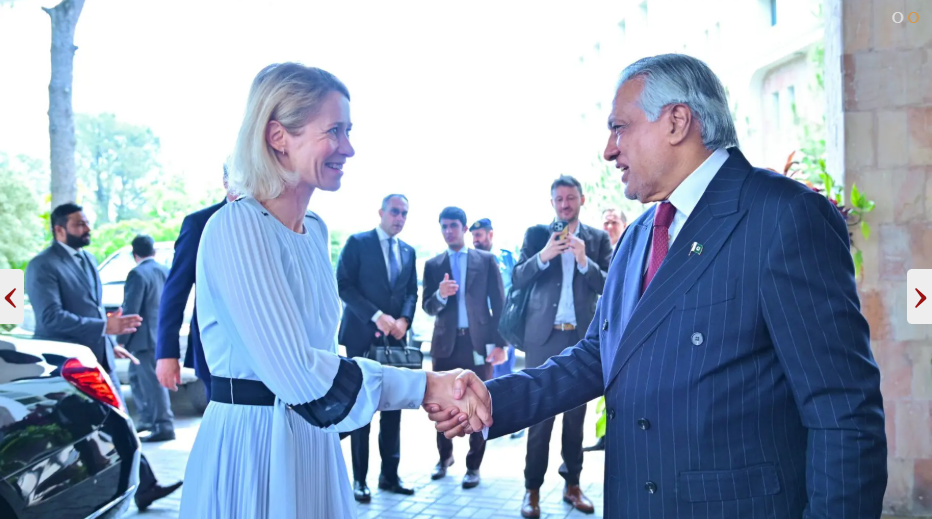
ISLAMABAD: The European Union’s (EU) top diplomat, Kaja Kallas, on Monday termed Pakistan a major regional power and an important partner of the EU as the two sides held a strategic dialogue in Islamabad.
Kallas, who serves as vice-president of the European Commission and the EU high representative for foreign affairs and security policy (HR/VP), is visiting Pakistan at the invitation of Deputy Prime Minister and Foreign Minister Ishaq Dar.
Both co-chaired the 8th EU-Pakistan Strategic Dialogue, which is the highest-level platform for structured discussion between the two sides.
Addressing a joint press conference, Kallas said, “Pakistan is a major regional power and an important partner for the European Union.
“Today, in our strategic dialogue, we affirmed our shared commitment to strengthening EU-Pakistan ties even further,” she stated.
Kallas noted that her visit came at an “important moment”, adding that the “world and this region have experienced profound changes” since the two sides met in November last year.
Kallas pointed out that the EU remained “by far Pakistan’s largest export destination”, adding that it was larger than the US and China combined.
She further said Pakistan was the “world’s leading beneficiary” of the EU’s Generalised Scheme of Preferences Plus (GSP+).
At the same time, Kallas stressed: “But GSP+ has clear conditions. Continued preferential access to the EU market depends on progress in implementing the international conventions underpinning the scheme.
“This includes good governance, environmental protection and particularly, labour and human rights. We look to Pakistan to demonstrate tangible progress on these issues.”
Kallas said Pakistan and the EU were deepening cooperation on a wide range of issues, including climate resilience, digital infrastructure, clean energy, migration and mobility. She remarked that people-to-people links were also an “important part” of the partnership.
“I’m also impressed that Pakistan tops the EU’s global Erasmus Mundus Scholarships rankings again, the fifth year in a row,” she said.
Providing details of the dialogue, the visiting diplomat said she and Dar exchanged views on “pressing global developments, including in the Middle East”.
Noting Pakistan was the “main mediator” between the US and Iran, Kallas told Dar: “Your diplomatic efforts have helped prevent a return to full-blown war on several occasions and these efforts are much recognised and appreciated across Europe.”
She added, “With your support, there is now a tenuous diplomatic opening to extend the ceasefire and reopen the Strait of Hormuz. Yet, any temporary understanding between the US and Iran must be followed by deeper talks about Tehran’s nuclear stockpile and other critical issues.
“Lasting stability will require more encompassing solutions,” she emphasised, affirming that the EU was ready to contribute to a sustainable and peaceful solution.
“We bring economic leverage, hard-won nuclear expertise, long-standing relationships with partners across the Gulf and direct engagement with Iran itself,” Kallas said.
“I see a concrete role for the EU in helping to make any eventual agreement durable, whether through maritime operations, economic incentives that support long-term stability or other issues.”
The EU diplomat also noted that Pakistan had been “locked in a conflict with Afghanistan”, adding that the fighting in recent weeks had “grave humanitarian consequences and also risks fuelling further instability and radicalisation”.
“This is why we have constantly called on both sides to exercise restraint and de-escalation. Pakistan has the right to defend itself and its people in line with the international law,” she said.
Speaking at the joint press conference, Dar termed Kallas’s visit a “significant milestone” in Pakistan-EU bilateral relations.
Dar said that the gap between the last EU-Pakistan dialogue in November 2025 and this one was “probably in our history the minimum between any two states”. He noted that the last visit by the EU high representative took place in 2019, followed by “virtually no visits for seven years”.
Therefore, he added, Kallas’s visit “signifies the growing momentum in EU-Pakistan partnership”. He noted that the EU high representative has remained his “frequent interlocutor”, adding that their candid exchanges reflected the trust between Pakistan and the EU.
“We have been constantly in touch during the last year’s India-Pakistan war and so are we in touch during the regional conflict between the US and Iran,” Dar said.
“We believe that the EU as an institution embodies the universal ideals of peace, diplomacy, democracy and commitment to human rights,” he said, affirming that Islamabad remained committed to constructive engagement with the EU and its member states.
During the dialogue, Dar said, both sides took stock of progress made on cooperation under the sectors outlined in the Strategic Engagement Plan (SEP) 2019, including trade, investment, development, human rights, and rule of law, migration and mobility, and security and counterterrorism.
Dar further noted that the EU was among Pakistan’s major trading partners, with a trade volume of €12 billion.
“Pakistan-EU trade cooperation under the GSP+ framework is a win-win template,” the deputy PM remarked.
“Our discussions today focused on further enhancing bilateral trade and investment ties between the EU and Pakistan,” Dar reiterated, detailing that both sides also assessed the “first-ever Pakistan-EU Business Forum in April as a welcome development”.
Dar expressed hope that the business forum could become a “regular feature” of Pakistan-EU ties. He said the two also held an “in-depth” discussion on regional and global issues, which included the “US-Iran conflict, the security situation in South Asia, Afghanistan, Europe and the Middle East”.
At this, Dar expressed appreciation to the Kallas for the EU’s “appreciation and support” to Pakistan’s efforts in the US-Iran conflict.
“We are humbled by the recognition of our efforts and will continue to work towards finding a comprehensive and lasting solution to the conflict,” Dar told Kallas.
On India-occupied Kashmir, Dar said he “apprised her excellency of our concerns regarding unprovoked Indian aggression and Pakistan’s principal position on the Jammu and Kashmir dispute, advocating for its resolution according to the wishes of the Kashmiri people in line with UN Security Council resolutions”.
He also briefed the EU high representative on Pakistan’s position on the Indus Water Treaty (IWT), recalling the May 15 supplemental award by the Permanent Court of Arbitration (PCA).
“Pakistani position on IWT stands vindicated after the court of arbitration’s supplemented award in the IWT proceedings arising from the Ratle and Kishanganga hydroelectric plant disputes.
About The Author